The Society's Flamsteed Observatory is situated a couple of miles north of the village of Brailsford, in rolling countryside to the north-west of Derby. It is named in honour of John Flamsteed (1646-1719), England's First Astronomer Royal, who was born in the village of Denby, also a few miles north of Derby. While living at his father's house on what is now 27 Queen Street in Derby, Flamsteed made groundbreaking astronomical observations, before he later moved to London and began work at Greenwich.
The Flamsteed Observatory currently houses a 10-inch Meade Schmidt-Cassegrain telescope, mounted on an EQ6-Pro computerised 'GOTO' mount and pier under a rotating dome. This telescope is primarily used for visual observations of the moon, planets and deep sky objects under our dark skies. An 80mm Altair ED refractor is piggybacked on the Meade, and is connected to an Altair GPCAM camera, which provides a live viewing experience on-screen. This setup was installed in 2022 to replace the older 10-inch Newtonian telescope and 'push-to' mount. A major upgrade of the observatory power supply and electrics was also undertaken at this time. As the observatory if 'off the grid', power is sourced from an array of solar panels mounted on the building, which charge a set of batteries, and both 12v DC power and 240v AC is available, the latter via an inverter.
Monthly observing sessions are held at the observatory, usually on the second Saturday of the month. These are open evenings at which both members and visitors are welcome. We also welcome visits by schools, scout, guide and other private groups. If you would like to attend an observing session or book a group visit please contact our Outreach Officer . The observatory may be found on Google Maps. Please note that anyone visiting our observatory and site, be they members or non-members, do so entirely at their own risk. Members are entitled to some training on the use of our Flamsteed Observatory, and when deemed competent may obtain a key to enable them to use the facility at any time.
The society's Flamsteed Observatory pictured in November 2023 by DDAS member Tony Wright. Picture Credit: Tony Wright.
An observing sesssion underway in May 2023 using the latest configuration of a 10-inch Meade Schmidt-Cassegrain telescope, mounted on an EQ6-Pro computerised 'GOTO' mount and Altair Astro pier. An 80mm Altair ED refractor is piggybacked on the Meade, and is connected to an Altair GPCAM camera, which provides a live viewing experience on-screen. Picture Credit: Mike Lancaster.
The Society first thought about constructing its own observatory as far back as 1982. The search for a suitable site did not, however, go entirely without incident. The first site to be considered was an
old pumping station that belonged to the Severn Trent Water Authority. The site was out in the country under a dark sky. Indeed, there was already a building on the site that could be converted into an Observatory, but the planning authorities turned down planning permission on the grounds of access.
The second candidate site was not all that far from where the observatory now stands. The choice in this case was a narrow piece of land that had access already available. But, unfortunately, planning permission was once again turned down, this time mainly due to objections from local people. During this time the Society was approached by a local farmer, who had heard about the Society's search for a piece of land. The farmer had a small piece of land lying fallow, and was more than happy to lease it to the Society. This time around the authorities were kind to us, and gave us planning permission.
Once the matter of a site had been settled, the Society had to deal with the tricky problem of raising the necessary funds to begin the first stages of construction. The Society staged a number of fund-raising events including sponsored bike rides, walks, raffles and so on. It was during this period that the Society approached various companies and organisations that may have been in a position to help in the construction of the Observatory. The response to this appeal was quite overwhelming. Derby City Council Grants Sub-Committee was also approached and awarded the Society a substantial sum.
In the meantime the construction of the observatory's original 12-inch Newtonian reflecting telescope was proceeding apace. The telescope was built entirely by Society member Dr Ed Spooner, who was later honoured at the opening ceremony by having the telescope named after him, in recognition of his contribution to the Society as a whole. In fact the telescope was completed long before the observatory building was!
The 12-inch Newtonian telescope built by Ed Spooner on display in Derby Museum in April 1984, before being installed at the Flamsteed Observatory. Picture Credit: Mike Lancaster.
The development of the site began on St. Patrick's Day, 17th March 1985. The first job was to clear away top soil for a car park, the first turf being cut by our Chairman at the time, Arthur Tristram. Over the next few weeks the ground was prepared for limestone aggregate to be put down for the car park. By mid-May 1985 an Observatory Sub-Committee had arranged for regular working parties to be held at the site. On 6th July 1985 the Society held its first summer barbecue at the site, a tradition that continues to this day. The foundations for the observatory itself were pegged out on 31st July 1985 and subsequently dug out by JCB.
The Flamteed Observatory site in June 1985. Work had begun on removing topsoil to create the parking area. Picture Credit: Mike Lancaster.
The foundation pit for the Flamteed Observatory in 1985.
John Hickling (left) and Ed Spooner work on the observatory foundations on the 5th October 1985. Note the shuttering for the central pillar. Picture Credit: Neil Breakwell.
The then Secretary of the Society and founder member, Jane Kirk, sent out letters to various large companies and interested parties to drum up support for the project. This bore fruit with a kind donation by Tarmac Ltd of 30 tonnes of limestone for the observatory foundations and car park, delivered on 25th September 1985. On 13th October nine Society members shifted around 15 tonnes of this limestone in the process of laying the foundations and car park. December 1st 1985 saw the shuttering put in place for the cement base of the observatory building.
In the spring of 1986 a path was laid between the car park and the observatory building. An attempt at getting the foundations completed had to be aborted when heavy rains meant the cement mixer was unable to drive past the boggy entrance to the site! A second attempt on 23rd August 1986 was successful when six members helped to lay the foundations. Two concrete hard pads were also placed at the site a few yards from the observatory itself for members telescopes.
Tarmac delivers a load of concrete to the site in August 1986.
Left to right: Mike Dumelow, Dave Maynard, Dave's son, Arthur Tristram and Arthur's daughter, levelling concrete for the observatory foundations in August 1986.
Left to right: Arthur Tristram's children, Arthur Tristram, Dave Maynard's son, John Hickling and Mike Dumelow after the concrete for the foundation is laid in August 1986.
The observatory foundations on the 9th November 1986. Picture Credit: Neil Breakwell.
The observatory foundations on the 11th January 1987. Picture Credit: Neil Breakwell.
On a snowy day on the 8th March 1987 the main frame of the observatory was transported to the site and erected. Eight members put the 5m x 5m structure together in 4 hours and another significant part of the site was complete. The frame was then painted by a couple of members over 3 evenings in September 1987. By December 1987 Ed Spooner had started work on the sections that would make up the dome.
The completed frame on the 8th March 1987. Left to right: Steve Parkins, Mike Dumelow, (---? behind Mike), Ed Spooner, John Holmes, Jane Kirk, and Andrew Johnson. Picture Credit: Neil Breakwell. More pictures of the frame assembly may be found here.
The frame of the observatory in the summer of 1987. Mike Dumelow is at right mowing the grass.
The freshly painted frame of the observatory in September 1987. Picture Credit: Neil Breakwell.
Next two photos: A work party doing general grounds maintenance at the observatory on the 5th June 1988. Picture Credit: Mike Lancaster. More pictures from this day...
The next major step was not until the summer of 1989 when the telescope pillar was built. The pillar was designed and constructed by Sam Baker and is comprised of a stack of square concrete sections, the whole filled with steel reinforced concrete. This provides a very stable platform for the telescope, and is isolated from the from the first floor level of the building to prevent vibration being transmitted to the instrument. Following assembly of the pillar came the construction of the dome ring, which forms base of the dome and the track upon which it runs. Credit is again due to Ed Spooner for the design and construction of this component.
Sam Baker (left) and John Holmes begin work on the pillar in the summer of 1989. Sam cast the sections at work in his lunch hour.
The completed pillar. Picture Credit: Neil Breakwell.
John Holmes (left) and Mike Dumelow with the completed pillar in the summer of 1989. Note that the frame has also been re-painted black.
The track for the dome is added. Summer 1989. Left to right: Steve Parkins, John Holmes, Ed Spooner.
The summer of 1989 also saw the completion of the first floor, together with a flight of stairs to allow access to it, all this work being done by Society members. By the end of that summer the panels which would form the walls of the building were delivered to the site, and the framework for the dome was installed.
John Holmes working on the timbers for the first floor in the summer of 1989.
DDAS members working on the observatory in the summer of 1989. Left to right at ground level: Steve Parkins, Mike Dumelow, Sam Baker, Matthew Dumelow, Anthony Southwell and Mike Lancaster. At dome level are Dave Cordery (left) and Andrew Johnson.
The completed stairs and pillar in the summer of 1989.
The completed observation deck in 1989. Picture Credit: Neil Breakwell.
DDAS members attaching the cladding to form the walls of the observatory in the summer of 1989. On the observation deck, left to right: John Hickling, Anthony Southwell, Steve Parkins and Mike Lancaster. At ground level, left to right: John Holmes, Matthew Dumelow and Mike Dumelow. Picture Credit: Neil Breakwell. More pictures of this work may be found here.
The cladding work as seen from the observation deck in the summer of 1989. Left to right: John Holmes, Matthew Dumelow, Mike Dumelow and Steve Parkins. Picture Credit: Neil Breakwell.
DDAS members working on the dome framework and roof edging in late 1989. Left to right: John Holmes, Sam Baker, Andrew Johnson and Dave Cordery. Picture Credit: Neil Breakwell.
A barbecue is held at the site in the summer of 1990. On the roof of the observatory left to right are DDAS members Anthony Southwell and Mike Lancaster, and Mike's friend Matthew Lenthall. On the ground left to right: Jane Kirk's husband David, Mike Dumelow's father-in-law William Shakespeare, Nicky Dumelow, Matthew Dumelow, Amanda Ensor, Jane Kirk, John Holmes, Sam Baker, Steve Parkins, Ed Spooner (seated) and son, Neil Breakwell, Mike Dumelow (in red T-shirt), Madeleine Holmes and daughters, and Dave Cordery (seated). Photo courtesy of Arthur Tristram.
During the summer of 1990 the dome was assembled at the site from separate aluminium segments, this work being completed by September that year. As it was now some time since the 12-inch telescope had been completed, the surface of the primary mirror had degraded to such an extent, that it was decided that it would have to be re-aluminised. This was done in early 1992 by Orion Optics of Crewe, Cheshire.
A completed dome segment is ready to be fitted. Summer 1990. More photographs of this work may be seen here.
The observatory with completed walls and dome.
The Ed Spooner Telescope inside the dome.
The Flamsteed Observatory was officially opened on October 2, 1992, by well known astronomer and TV presenter, Heather Couper, who was in turn accompanied by Nigel Henbest, science writer and presenter of Radio 4's The Litmus Test. The then Deputy Mayor of Derby, Robin Wood, also took part in the ceremony.
Heather Couper opens the Flamsteed Observatory on October 2nd, 1992. Meanwhile DDAS members Dave Maynard (left) and John Holmes (right) look on under their umbrellas.
Heather Couper with DDAS member John Holmes (right) at the opening of the Flamsteed Observatory on October 2nd, 1992.
Dave Maynard (left) stands next to the 12-inch Newtonian reflector designed and built by Ed Spooner, inside the dome of the Flamsteed Observatory, on the 6th August 1993. Picture Credit: Alan Heath.
The 12-inch Newtonian reflector designed and built by DDAS member Ed Spooner, inside the dome of the Flamsteed Observatory, on the 6th August 1993. Picture Credit: Alan Heath.
The original 12 inch telescope was of open frame design and sat in a massive concrete horseshoe mount. Due to problems which developed with this mount the Ed Spooner Telescope was replaced in the summer of 1996 by a 10 inch Newtonian reflector built by Rod Tippet. Originally constructed by Rod in 1986 this telescope was also of an open frame design. This instrument also had a 3 inch refracting telescope with a CCD camera attached to it. The re-furbished Observatory was officially re-opened on Monday August 19, 1996 on the 350th Anniversary of the birth of John Flamsteed. Mr Alan Heath, local astronomer and former Director of the British Astronomical Association's Saturn Section, conducted the re-opening ceremony.
Left to right: Mike Dumelow, Rod Tippet and Alan Heath at the re-opening of the Flamsteed Observatory by Alan on the 19th August 1996. Picture Credit: Alan Heath.
The newly refurbished Flamsteed Observatory at its re-opening on the 19th August 1996. Picture Credit: Alan Heath.
Next two photos: The 10-inch 'Rod Tippet' telescope inside the dome.
In 2022 the observatory underwent a major upgrade of both optics and electrics, with the 10-inch 'Rod Tippet' telescope and mount being replaced by a 10-inch Meade Schmidt-Cassegrain telescope, mounted on an EQ6-Pro computerised 'GOTO' mount, with a piggybacked Altair ED-80 refractor and CMOS camera. In 2023 the EQ6-Pro mount was given a full strip down, clean and service by Rother Valley Optics, as well as a Rowan belt upgrade. In 2025 the Synscan handset was replaced by a mini-PC running Stellarium telescope control via EQMOD and ASCOM.
In 2022 the 10-inch 'Rod Tippet' telescope was replaced with 10-inch Meade Schmidt-Cassegrain telescope, mounted on an EQ6-Pro computerised 'GOTO' mount, with a piggybacked Altair ED-80 refractor and CMOS camera. Picture Credit: Mike Lancaster.
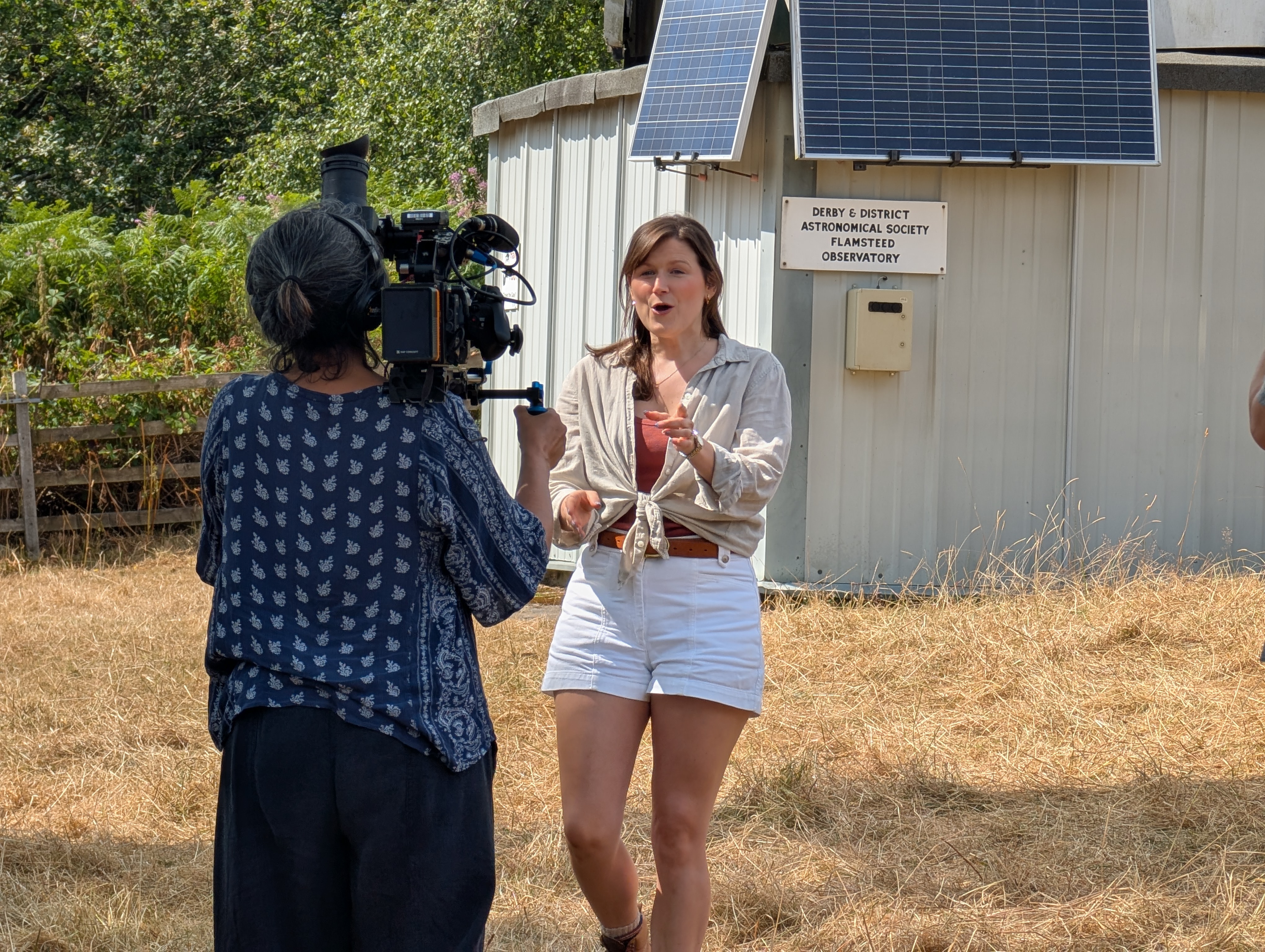
On the 21st July 2026 the observatory played host to Dr Becky Smethurst from the University of Oxford, along with a production crew from the BBC, filming for the August 2026 edition of The Sky at Night. Becky also filmed her own monthly night sky guide for her highly popular YouTube channel Dr Becky - and you can watch that video here. More pictures from that visit can be seen here. Picture Credit: Mike Lancaster.